Cheyenne, Wyoming – the state capital with roughly 65,000 residents – often draws newcomers looking for a low-stress Western lifestyle. To gauge whether Cheyenne is truly budget-friendly, this analysis looks at the city’s real costs. We examine housing prices, rent levels, taxes, utilities and other living expenses. Overall, Cheyenne’s cost of living is roughly on par with U.S. averages. The data suggests that housing and everyday costs in Cheyenne tend to be modest, thanks in part to Wyoming’s low tax burden. This guide will help buyers and renters understand what to expect in Cheyenne’s housing market and day-to-day expenses.
Cheyenne, WY Cost of Living at a Glance
Cheyenne’s overall cost index is close to the national average. PayScale reports that Cheyenne’s composite cost of living is about 1% lower than the U.S. norm, meaning most expenses will neither dramatically exceed nor fall far below what you’d pay elsewhere. The median household income in Cheyenne is around $78,000 (2023), which is healthy for a city of this size. Notably, Wyoming has no state income tax and only a moderate sales tax (4–6%), so take-home pay typically stretches farther than in many states. The homeownership rate is high – about 70.8% of Cheyenne housing units are owner-occupied – reflecting a community with a strong stake in local property.
Despite recent price increases, Cheyenne housing remains relatively affordable by national standards. The U.S. Census (ACS) data shows Cheyenne’s median home value is about $324,900 (2023). Zillow reports the average Cheyenne home value at roughly $377,833 as of late 2025, and Redfin puts the median sale price around $379,000 (Oct 2025). By contrast, national median home prices are much higher; Redfin notes Cheyenne’s median sale price is about 48% below the national median. In short, homes in Cheyenne sell for well below the average U.S. price, though local wages are correspondingly lower than in big metros.
Housing Costs for Buyers in Cheyenne
For homebuyers, Cheyenne’s market offers good value. Recent trends show modest price growth – about +3–6% year-over-year – but median sales still hover around the high $300Ks. Using a rough affordability ratio, Cheyenne’s median home price (≈$375–380K) divided by median income (~$78K) is around 4.8, higher than the traditional 3.0 benchmark. This suggests buyers will need a solid down payment and income to cover mortgage and costs. However, compared to pricier metro areas (where ratios often exceed 6–7), Cheyenne remains reasonably accessible.
Important factors for buyers in Cheyenne include property taxes and financing. Wyoming’s effective property tax rates are generally low, and Laramie County (Cheyenne’s county) often has some of the state’s lowest property tax burdens. Buyers should also note current interest rates and get pre-approved, as many Cheyenne home purchases are financed. Typical single-family homes, townhouses, and condos are available at these prices; the market is not extremely tight, with median days on market around 32 days in late 2025, so buyers have some negotiation room.
Key points about buying in Cheyenne:
- Median Home Price: About $325K–$380K (2023–2025), roughly 48% below U.S. median.
- Homeownership Rate: High (≈70.8% in 2023).
- Annual Price Change: Moderately rising (+3–6% YoY as of late 2025).
- Mortgage Affordability: A buyer might need an income in the upper 5-figures or more to comfortably qualify for a typical Cheyenne mortgage, depending on down payment.
Overall, Cheyenne’s housing costs are relatively low for buyers. The city’s median home price compares favorably to national averages. Combined with no state income tax, homeownership in Cheyenne can be a good deal for those who can meet the financial requirements.
Renting in Cheyenne: Prices and Considerations
Renters in Cheyenne also find generally affordable rates. Market data indicates that median rents are around $1,000 per month. For example, Redfin reports the median rent in Cheyenne was about $1,023 in early 2024. More detailed breakdowns show a one-bedroom apartment averages roughly $925, and a two-bedroom around $1,100. These rents are notably lower than in most major cities, making Cheyenne attractive for individuals and families on modest budgets.
Rent levels have been relatively stable. Redfin notes only small month-to-month changes (e.g. a slight dip of 2.6% in spring 2024). Vacancy rates are moderate (roughly 8–9% according to local data), so renters generally have options but should act quickly on desirable units. Utility costs (electricity, gas, water) are typically passed on separately, but as noted below Cheyenne’s utilities are generally cheaper than many places.
Helpful tips for renters in Cheyenne:
- Budgeting: With median rent ~ $1,000, a renter with a ~$3,000–$4,000 monthly income would be following the conventional guideline of paying ≤30% of income on rent.
- Lease Costs: Expect a security deposit (often 1 month’s rent) and possibly application fees. Rents below $800 are rare; most rentals fall in the $800–$1,500 range.
- Unit Types: Most rentals are 1–3 bedroom apartments or houses. Larger 3+ bedroom units (often single-family homes) can reach $2,300+.
- Neighborhoods: Cheyenne has several districts (e.g. Fox Farm, Westridge, Historic Downtown); rents vary by area. Always check commute and amenities.
In summary, renting in Cheyenne is quite affordable for Wyoming standards. A couple or small family can find a 2–3 bedroom place for around $1,100–$1,500/mo in many neighborhoods, which is relatively low cost relative to incomes.
Utilities, Taxes, and Other Living Expenses
Beyond housing, Cheyenne residents enjoy lower-than-average costs in several key categories. Utilities in Cheyenne (electricity, natural gas, etc.) are about 11% below the U.S. average. This reflects Wyoming’s relatively low energy prices. Similarly, transportation costs (gasoline, public transit fares) run a few percent below average. For instance, AAA reports Cheyenne’s average gas price around $2.46/gal (Dec 2025), versus a national average near $2.94/gal. Short commutes (≈17.9 min on average) and plentiful free parking further reduce transportation spending.
Groceries and food are roughly on par with the national norm. PayScale notes that grocery costs in Cheyenne are only about 1% higher than the U.S. average. To give a sense of scale, a loaf of bread may run about $4.00 and a gallon of milk $4.75 (prices fluctuate). Overall food inflation has been moderate, so budgeting for groceries should be similar to anywhere in the country. Health care costs in Cheyenne are slightly above average (≈2% higher), as Wyoming’s rural medical market can be pricier. Health insurance premiums will depend on personal factors, but expect healthcare to be only a modest cost-driver.
Taxes are a major affordability win in Cheyenne. Wyoming has no personal income tax and no corporate income tax, which is unique among U.S. states. The state’s sales tax is 4%, and Cheyenne adds about 2% in local taxes (total ~6%), which is lower than many states’ combined rates. For buyers, property taxes are also quite low compared to the national average. This tax structure means more of your earnings stay in your pocket, effectively reducing overall living costs.
Summary of Non-Housing Costs:
- Utilities: ~11% below U.S. average.
- Gasoline: Around $2.45/gal (Dec 2025, AAA), well under the national average.
- Groceries: ~1% above U.S. average.
- Sales Tax: Wyoming 4% + local ~2% (no income tax).
- Healthcare: Slightly higher (+2%) than national average.
Taken together, these numbers show that everyday living in Cheyenne is generally budget-friendly. Lower utility bills and fuel costs offset slightly higher grocery and healthcare costs, while tax savings further enhance affordability.
Comparing Cheyenne to Other Areas
It’s useful to put Cheyenne’s costs in context. Compared to large cities, Cheyenne is much cheaper. For example, Denver or San Francisco have median home prices well over $600K–$1M, far higher than Cheyenne’s ~$380K. Rents in Denver often average $1,800–$2,000 for similar units, compared to ~$1,000 here. Even within Wyoming, Cheyenne is moderately priced – rural rents can be cheaper, but Cheyenne still beats suburban L.A. or Seattle easily. Relative to the national average, Cheyenne’s overall cost index is roughly 100 (neutral), meaning it is neither a bargain basement nor an outrageously expensive place.
For households comparing earnings vs cost of living: Cheyenne’s median household income (~$78K) helps offset its expenses. In practice, many Cheyenne residents can afford a comfortable lifestyle. A single earner making $50K can cover basic living costs here, while a dual-income family making $80–100K will find most homes within reach and still have disposable income. Of course, personal budgets vary, but Cheyenne’s more modest cost profile means local salaries go further than in high-cost states.
Tips for Buyers and Renters in Cheyenne
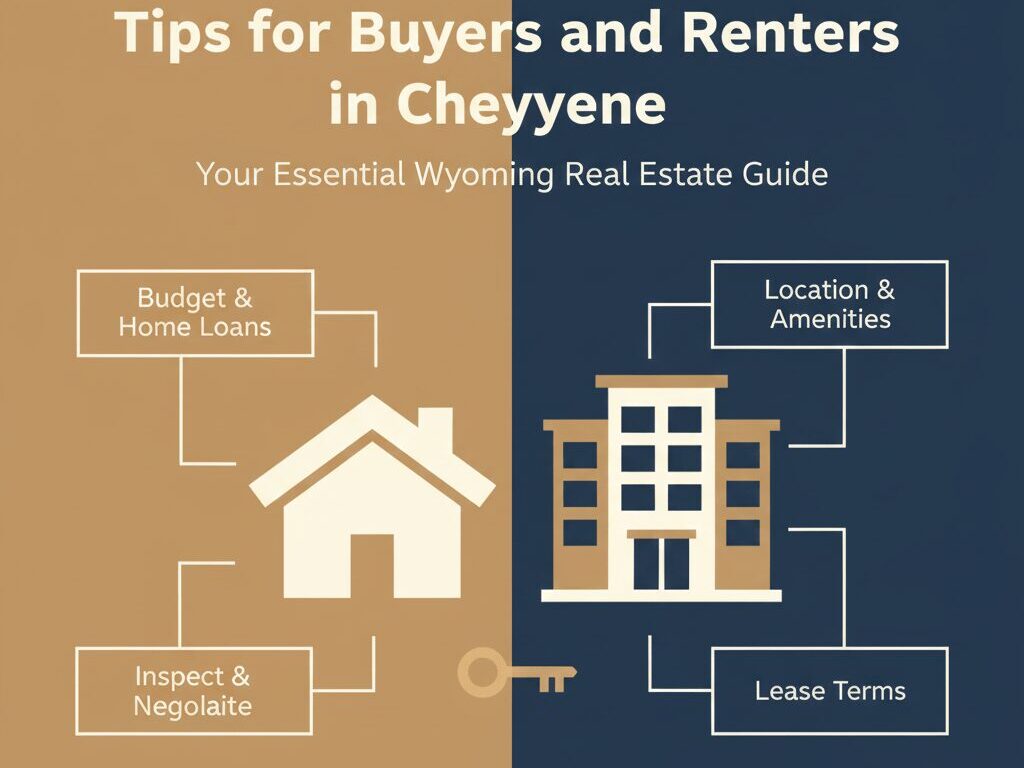
To make the most of Cheyenne’s affordability, consider these pointers:
- Get Pre-Approved: Buyers should shop mortgage rates early. Cheyenne’s housing market is stable, but obtaining loan pre-approval helps narrow your budget and makes offers stronger.
- Budget Carefully: Factor in property taxes, insurance, and HOA fees (if any). Even with low taxes, these add a few hundred dollars monthly. For renters, remember utility costs and renter’s insurance.
- Explore Programs: First-time homebuyers may qualify for Wyoming down-payment assistance programs or VA loans (given the nearby F.E. Warren AFB). Investigate any state or federal aid that can reduce upfront costs.
- Check Commute and Schools: When choosing a neighborhood, consider commute times (Cheyenne’s are short on average) and school quality. Living slightly farther out can lower rent/mortgage.
- Negotiate Rent or Price: Given moderate vacancy rates and inventory, don’t hesitate to negotiate. In tight markets, small concessions (like one month free rent) may be possible, especially off-peak.
In sum, Cheyenne can be an affordable place to call home – but careful planning pays off. Buyers should prepare for rising home prices, while renters should lock in deals in good neighborhoods. Both should take advantage of Wyoming’s tax benefits and enjoy Cheyenne’s relatively low everyday costs.
Conclusion
Cheyenne, WY offers a reasonably affordable lifestyle compared to many U.S. cities. Housing costs (both buying and renting) are below national averages, and local salaries are competitive for the region. Daily expenses like utilities and fuel tend to be lower than in big metros, and Wyoming’s tax structure (no state income tax) further boosts affordability. For prospective buyers and renters, Cheyenne’s moderate prices mean that with a solid income and budget, one can secure a home or rental without overextending finances. In short, Cheyenne, WY proves to be an affordable option for many looking to settle in the Rockies, with a blend of low taxes and modest housing costs supporting residents’ wallets.
Frequently Asked Questions
Is Cheyenne expensive to live in?
Cheyenne’s overall cost of living is close to the U.S. average. Housing is notably cheaper than national norms (about 48% below the U.S. median home price), and key expenses like utilities and gas are below average. While groceries and healthcare run roughly at or just above average, the lack of state income tax makes Cheyenne relatively affordable compared to many cities.
What is the average home price in Cheyenne, WY?
Recent data shows the median sale price of a home in Cheyenne around $375K–$380K (late 2025). U.S. Census data cites a median property value of about $325K (2023). In any case, home prices in Cheyenne remain well below most major city markets.
What is the average rent in Cheyenne, WY?
The typical rent is about $1,000 per month. According to rental market trackers, Cheyenne’s median rent was around $1,023 in early 2024. Apartments run roughly $925 for one-bedroom and $1,100 for two-bedrooms. So most renters pay in the $900–$1,200 range, depending on size and location.
How does Cheyenne’s cost of living compare to the U.S.?
Cheyenne is roughly at parity with the national cost of living. That means about 100 on a cost-of-living index. Housing is lower, which keeps the index near average. Some categories (utilities, transportation) are notably cheaper, while others (groceries, healthcare) are just a bit higher.
What salary do I need to live comfortably in Cheyenne?
This varies by lifestyle. A single person can live modestly on ~$40K/year, while a family of four might need $70–80K to cover mortgage/rent and living expenses comfortably. For context, a salary of $80K is around the city’s median household income. Those figures assume prudent budgeting; earning more than median provides greater flexibility for buying or renting a nicer home.
What are typical living expenses in Cheyenne (utilities, taxes)?
Utility bills in Cheyenne tend to be lower than average (about 11% below U.S. norms), and fuel prices are modest (roughly $2.45/gal for regular gas). Sales tax is about 6% total (4% state + local), and there is no state income tax. Groceries cost roughly what they do nationwide. Overall, residents find that everyday essentials do not carry a hefty premium compared to elsewhere.